AI Act - Czech Draft Law on Artificial Intelligence

%22%3E%3Cpath%20d=%22M12.12%201.176c5.846.0%2010.591%204.615%2010.591%2010.299.0%205.683-4.745%2010.298-10.591%2010.298-5.845.0-10.591-4.615-10.591-10.298.0-5.684%204.746-10.299%2010.591-10.299zM6.331%2017.264H17.91C18.308%2017.264%2018.649%2017.123%2018.932%2016.839%2019.216%2016.556%2019.358%2016.215%2019.358%2015.817V7.132C19.358%206.734%2019.216%206.394%2018.932%206.11%2018.649%205.827%2018.308%205.685%2017.91%205.685H6.331C5.932%205.685%205.592%205.827%205.308%206.11c-.283.284-.425.624-.425%201.022v8.685c0%20.398.142.739000000000001.425%201.022C5.592%2017.123%205.932%2017.264%206.331%2017.264zm0-8.684%205.789%203.618L17.91%208.58v7.237H6.331V8.58zm0-1.448H17.91l-5.79%203.619L6.331%207.132z%22%20style=%22fill:%238a959b%22/%3E%3C/g%3E%3C/svg%3E)
The Ministry of Industry and Trade (MPO) has prepared a draft law on artificial intelligence, which implements the European regulation on artificial intelligence, known as the AI Act. The draft law complements the AI Act and sets out how this regulation will be applied in the Czech Republic. Among other things, the AI draft law determines which authorities will carry out supervision, how the authorization and testing of high-risk AI systems will function, and introduces penalties for breaches of obligations.
In terms of its substantive scope, this is a new piece of legislation. The draft introduces an independent legal regulation of the field of artificial intelligence, which has so far been absent from the Czech legal system. It provides a comprehensive and coherent framework, including supervision, procedures, and sanctions.
In the article, you will learn that:
- The Czech Republic is preparing its first dedicated law on artificial intelligence, which will complement the European AI Act.
- The Czech Telecommunication Office is proposed as the primary supervisory authority, with other state bodies supporting its activities.
- Under what conditions high-risk AI systems can be tested and operated in real-world environments.
- What the newly established regulatory sandbox will offer to innovative companies, and what risks arise from breaches of obligations.
The draft law includes the following:
Supervision of Compliance with Rules
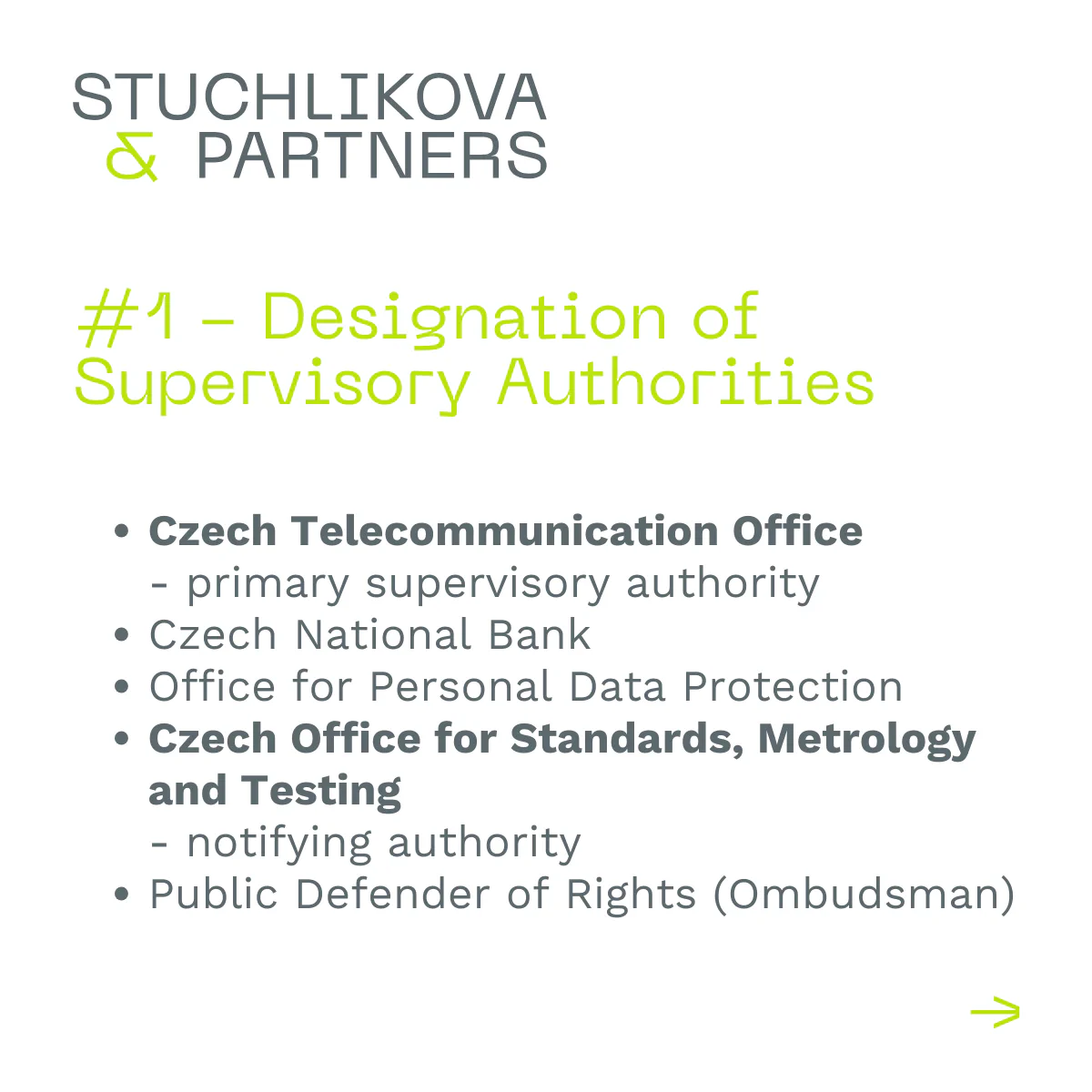
Supervision is to be divided among several authorities. The Czech Telecommunication Office is designated as the primary supervisory authority and will act as the single point of contact. Other supervisory authorities include the Czech National Bank and the Office for Personal Data Protection. The Czech Office for Standards, Metrology and Testing will act as the notifying authority and will be responsible for the accreditation of conformity assessment bodies. In matters concerning the protection of fundamental rights and freedoms of individuals, the Public Defender of Rights (Ombudsman) will play a significant role.
As for supervision, Section 17 of the draft law states that in exercising supervision over compliance with obligations under the AI Act and the draft law, the aforementioned supervisory authorities shall proceed in accordance with the law governing market surveillance of products and the directly applicable European Union regulation governing market surveillance of products.There is also to be an exchange of information between the Czech Telecommunication Office and the Office for Personal Data Protection. These authorities will notify other market surveillance bodies of the initiation of inspections or proceedings under this law and the subject matter of such inspections or proceedings.
The draft law also provides for the issuance of opinions if proceedings conducted by a market surveillance authority under the AI Act or the draft law relate to compliance with cybersecurity requirements for AI systems set out in the AI Act. Such opinions will be provided by the National Cyber and Information Security Agency (NÚKIB). This authority may also request opinions regarding legal regulations on the processing and protection of personal data from the Office for Personal Data Protection.
High-Risk Artificial Intelligence Systems
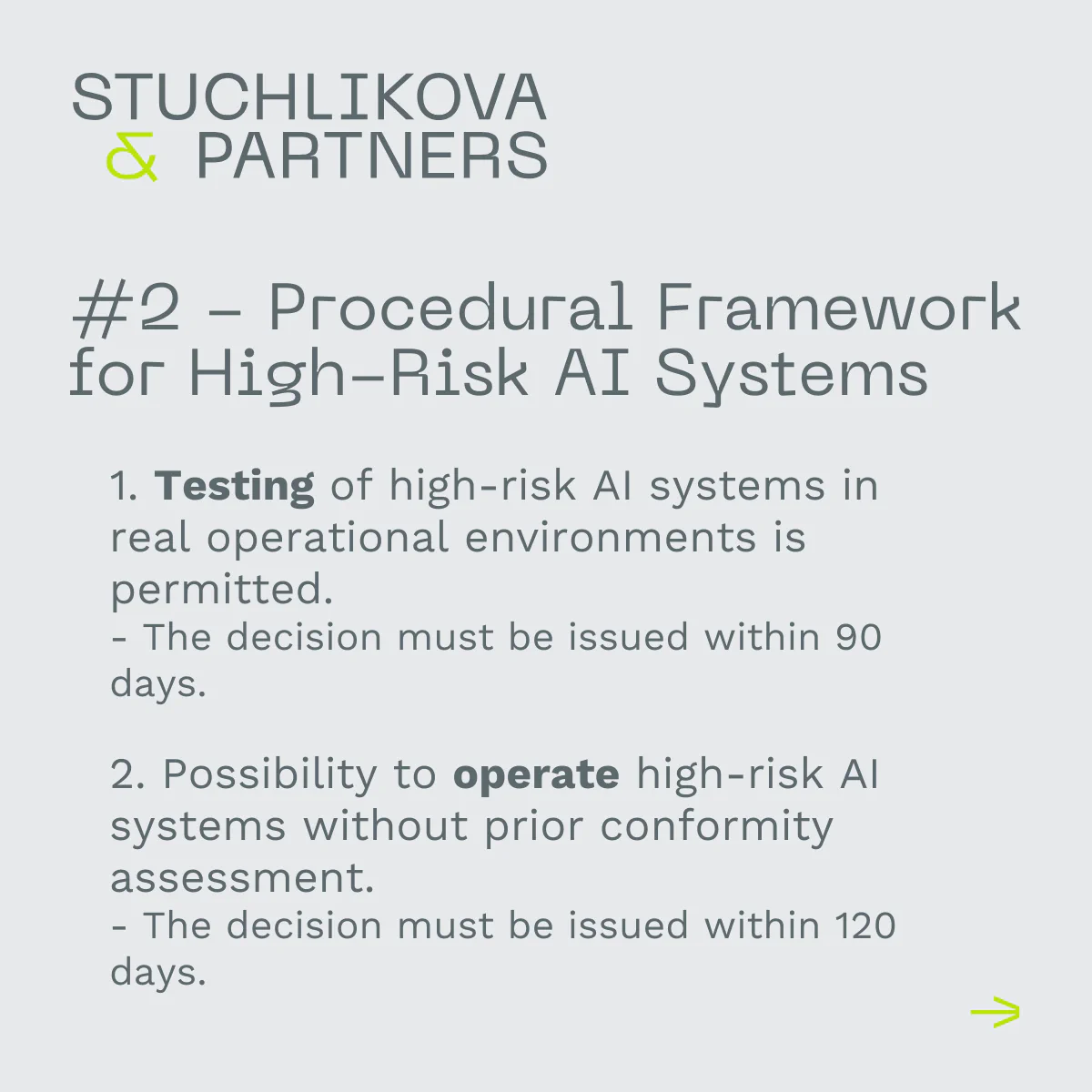
The AI Act allows, under certain specified conditions, for the testing of high-risk AI systems in real operational environments. It also permits the operation of such systems without prior conformity assessment, provided certain criteria are met. If a supervisory authority detects a breach of any provision of the AI Act, it is authorized to impose corrective measures on the obligated entity. The draft law establishes a specific procedural framework for this, including deadlines and administrative procedures.
In general, this is a more complex administrative process, but it includes clearly defined time limits:
- A 90-day period is set for a decision on the authorization of testing,
- A 120-day period is set for a decision on the authorization of operation.
Establishment of a Regulatory Sandbox for Artificial Intelligence and Some Conditions for Its Operation
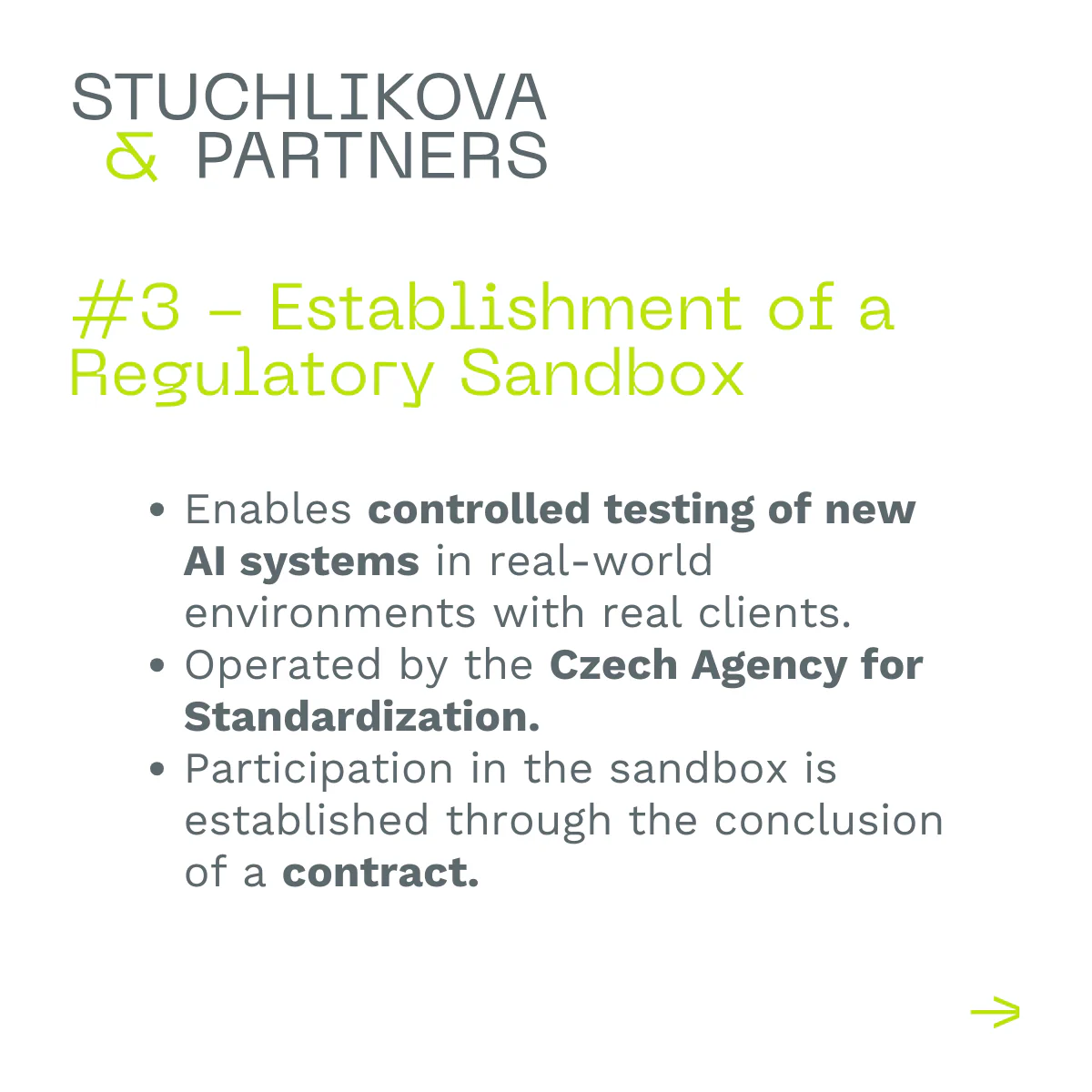
The draft law also provides for the establishment of a so-called regulatory sandbox for AI. The regulatory sandbox will be operated by the Czech Agency for Standardization. Its primary purpose is to support small and medium-sized enterprises that wish to develop AI systems and engage with the state from the early stages—testing new AI in real-world environments and with real clients, with state cooperation. This represents a form of “controlled testing of AI in operation,” enabling verification of the functionality and safety of AI systems before they are placed on the market.
A key condition for participation in the AI regulatory sandbox is that entry is based on a signed agreement. This means that submitting an application to participate does not automatically entitle the applicant to take part. The eligibility requirements and selection criteria will be set by the Czech Agency for Standardization and published on its official website.
Warning for Breach of Obligation and Offences
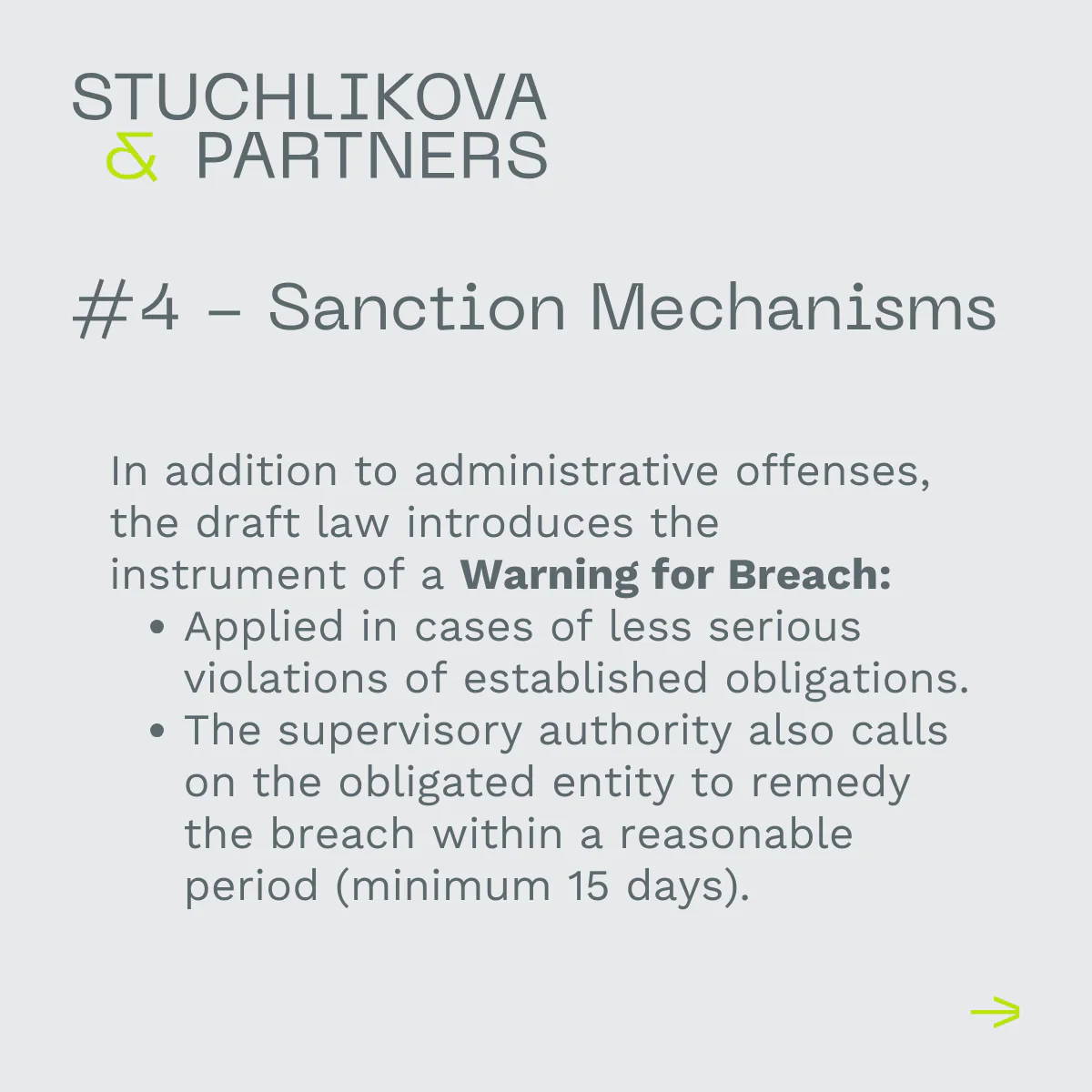
Finally, it should be noted that if an obligated entity breaches a duty set by the AI Act in a less serious manner, the competent market surveillance authority may issue a warning and request that the entity remedy the breach within a reasonable time frame. This period must not be shorter than 15 days from the date the warning is delivered.
Offences are addressed in the final provisions of the draft law, specifically in Sections 21, 22, and 23.
It is anticipated that the law could come into force during 2026.
Our law firm is closely monitoring developments in AI legislation and brings you a clear summary of the most important changes proposed by the Ministry of Industry and Trade.
For more information about our AI-related services and legal consulting, feel free to contact us at info@stuchlikova.com.